
How Do Movies Make Money on Streaming Services? The Complete Guide (2026)
The money-making process in the movie industry has undergone a radical shift in the past ten years.
In the past, box office revenue was the only thing that mattered. If a movie didn’t do well at the box office, it was a failure. But now, with the rise of streaming services such as Netflix, Amazon Prime Video, Disney+, and Hulu, the movie industry has undergone a complete transformation.
The question on everyone’s lips is:
How do movies actually make money on streaming platforms?
Do they make money per view?
Do actors get paid per stream?
Is streaming more profitable than box office revenue?
In this comprehensive guide, we will walk you through the nitty-gritty of how movie revenue is generated on streaming platforms in 2026.
The Shift From Box Office to Streaming
Conventional sources of revenue for the film industry were:
Ticket sales at theaters
Sales of DVDs & Blu-ray discs
Televised broadcasting rights
Merchandising
However, with the advent of digital media, the industry has now moved towards on-demand content.
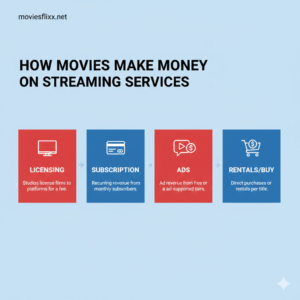
Currently, there are three dominant business models for streaming services:
Subscription-based (SVOD)
Rental or Pay-Per-View (TVOD)
Ad-Supported (AVOD)
Each of these models has a distinct source of revenue.
Let’s discuss them in detail.
1. Licensing Deals: The Most Common Way Movies Make Money
This is the most crucial source of revenue for most movies.
How Licensing Works
A streaming service pays a fixed fee to a studio or distributor in exchange for streaming rights for a movie for a fixed period of time.
Example:
Netflix may pay $20 million to stream a movie worldwide for 3 years.
Amazon Prime may pay $5 million for regional rights.
After that, the studio makes money upfront, irrespective of how many people watch it.
Why Studios Love Licensing
Guaranteed revenue
Less financial risk
Global reach
This is particularly helpful for movies that have a mid-range budget and may not do well in theaters but could do well on the streaming service.

2. Subscription Video on Demand (SVOD)
Services such as Netflix and Disney+ are subscription-based.
The users pay a certain amount every month:
$8 to $20, depending on the package chosen.
The amount is put into a huge pool, which is then used by the service for:
Payment of licensed content
Production of original content
Marketing and operational costs
The movies themselves do not generate any revenue based on the number of views. They contribute to:
Attracting new subscribers
Preventing cancellations
Adding value to the service
For instance, when a blockbuster movie is released, the number of subscriptions tends to increase.
3. Transactional Video on Demand (TVOD)
TVOD stands for the rental or purchase option.
On Amazon Prime Video, customers can:
Rent a movie for $3.99-$6.99
Buy the movie digitally for $12.99-$19.99
Every purchase earns direct revenue.
This is most ideal for:
Newly released movies
Early access to premium content
Blockbuster releases that bypass theaters
The production company usually takes a cut of every purchase, and the platform earns a distribution fee.
4. Ad-Supported Video on Demand (AVOD)
Some of these platforms enable viewers to watch movies for free while watching advertisements.
Examples of such platforms include:
Tubi
Pluto TV
Here is how it works:
Viewers are required to watch advertisements while watching the movie.
The advertisers pay the platform for the advertisements.
The revenue generated is shared with the content owners.
The more views the movie receives, the more advertising revenue it generates.
This business model is rapidly growing as advertisers are moving from traditional TV to streaming platforms.
5. Streaming Originals: A Different Profit Model
- When platforms create their own content, the business model shifts.
For instance, the movie Red Notice was created by Netflix.
Instead of selling movie tickets, the movie aimed to:
Attract new customers
Boost brand dominance worldwide
Compete with other brands
Original content on streaming platforms is viewed as a long-term investment.
Even if the movie does not generate direct revenue from ticket sales, the movie can:
Decrease churn rate
Boost user engagement
Enhance platform loyalty
6. International Distribution Rights
Many movies make money more than once.
A movie can:
Come out in local theaters
Sell international streaming rights
Later switch to ad-supported platforms
For example:
A Bollywood movie can come out in Indian theaters and then sell international streaming rights to Netflix for millions.
This second deal can sometimes make more money than the box office.
7. Performance Bonuses & Actor Contracts
Do actors get paid money per stream?
Not usually.
However, leading actors negotiate contracts that include:
Upfront salary
Performance bonuses
Subscriber milestone incentives
In some cases, actors get bonuses if a movie hits certain streaming targets.
After the pandemic, many actors asked for compensation adjustments because streaming replaced theatrical releases.
8. Data Monetization & Audience Insights
The streaming services harvest a huge amount of data, which includes:
Viewing time
Completion rate
User preferences
Regional popularity
The data is useful for the platforms in the following ways:
Creating targeted content
Selling premium ad space
Improving recommendation algorithms
In a way, movies create an indirect source of revenue for the platform by enhancing the data ecosystem.
9. Brand Partnerships & Product Placement
Some of the streaming movies include:
Brand sponsorships
Product placements
Co-marketing partnerships
For instance, gadgets, autos, or clothing brands can pay to feature in the movies.
This is an additional source of income aside from streaming rights.
10. The Role of Algorithms in Movie Profitability
- Online streaming platforms employ algorithms to suggest movies to users.
If a movie:
Engages viewers for a longer period of time
Promotes binge-watching
Boosts user engagement
The movie is more valuable to the platform.
High engagement leads to:
Improved subscriber retention
Enhanced ad revenue (for ad-supported plans)
Increased competitiveness of the platform
Streaming vs. Box Office: Which Is More Profitable?
Let’s compare.
Box Office Model
Revenue streams:
Ticket sales
Concessions
International distribution
Studios usually get 50-60% of ticket sales.
Risk level: High
Marketing expenses: Enormous
Streaming Model
Revenue streams:
Licensing agreements
Subscription services
Ad revenue
Data value
Risk level: Lower (particularly in licensing)
Global reach: Immediate
For mid-budget movies, streaming is often a safer and more lucrative option.
Blockbuster movies still use theaters, but most studios have started to go hybrid.
How Much Can a Movie Earn on Streaming?
- There is no set amount.
Some estimates are:
Mid-budget movies: $5-$30 million licensing agreements
Big movies: $100 million+ licensing agreements
International rights: Tens of millions
For example, Netflix’s big-budget movies can cost more than $200 million, including production.
The profit formula is based on:
Subscriber acquisition
International performance
Marketing ROI
Why streaming Platforms Pay So Much
These services compete internationally.
They require something that are:
Exclusive content
The big names include
Global appeal
A single popular movie can:
Increase subscriptions internationally
Dominate headlines
Outperform rivals
This is why the platforms invest billions of dollars every year in content creation.
The Future of Movie Revenue in 2026 and Beyond
The industry is changing very rapidly.
The trends include:
Hybrid releases (theater and streaming)
Ad-supported subscription tiers
Global content investments
AI-powered personalization
The platforms are focusing on:
Reducing churn
Increasing engagement
Expanding into emerging markets
The revenue from streaming is expected to keep growing with the expansion of internet access across the world.
Frequently Asked Questions (FAQ)
Do movies get paid per view on Netflix?
No. Most deals are fixed licensing agreements or upfront production budgets.
Is streaming better than box office?
It depends on the movie’s scale. Streaming is safer for mid-budget films, while blockbusters often benefit from theatrical releases.
Do actors earn royalties from streaming?
Sometimes, depending on contract terms. Many negotiate bonuses based on performance metrics.
How do free streaming platforms make money?
Through advertising revenue (AVOD model).
Final Thoughts
The movie industry is no longer dependent on box office revenue for profit.
Currently, the movie industry makes money through:
Licensing agreements
Subscription services
Rentals
Advertisements
International distribution
Brand collaborations
The movie industry has changed from a high-risk venture to a diversified global business model due to streaming.
As the platforms continue to compete for viewers across the globe, the movie industry’s economics will continue to change.
This is one thing that is certain:
The movie industry will never go back to the old model due to the changes brought by this industry.